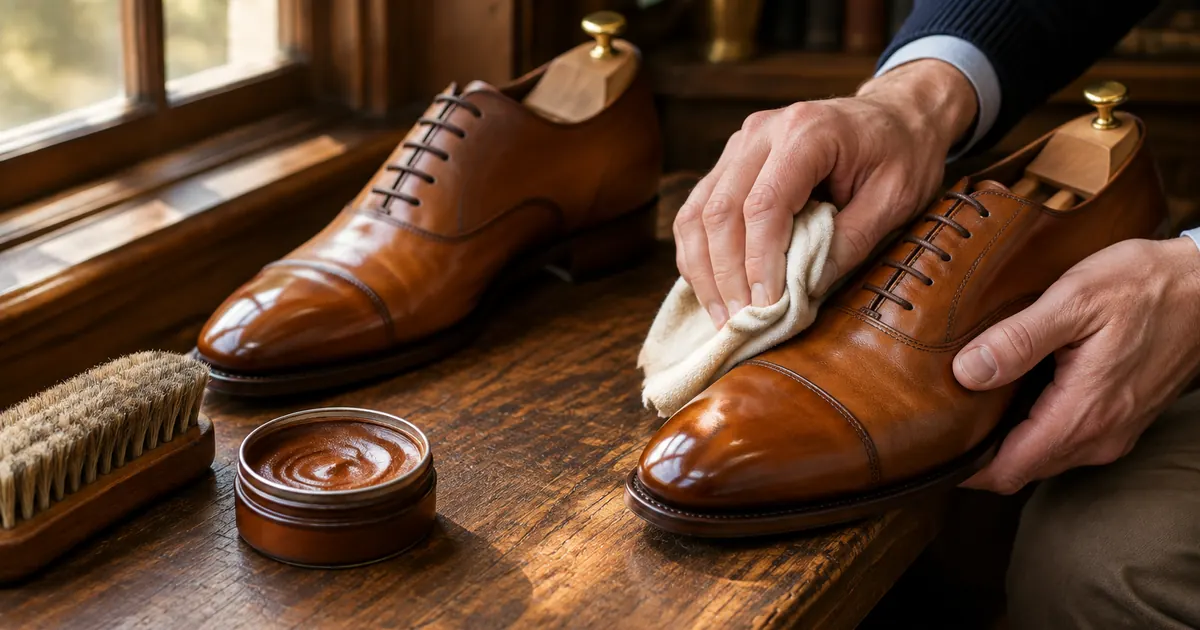
Leather is skin that is no longer attached to anything living — it dries, cracks and stains unless someone intervenes. The intervention takes five minutes a month and multiplies the life of a pair. Here is the complete routine, plus the mistakes that do the damage in the first place.
The monthly routine
Step 1: Wipe, do not wash
After wear — or at minimum once a month — wipe the uppers with a barely damp cloth. This removes the dust and road grime that work into the grain and dry it out. For our Men's Casual Leather Shoes, a soft brush along the stitching line lifts debris a cloth misses. Never run leather under a faucet or into a washing machine: saturation followed by drying is exactly how leather cracks.
Step 2: Condition when the leather looks thirsty
Conditioner replaces the oils that time and weather strip away. Once a month in winter, every six weeks in milder seasons, work a pea-sized amount of neutral cream into each shoe with a soft cloth — thin coats, circular strokes, then buff. Over-conditioning is real: it darkens leather and softens structure. If the leather looks rich and never shows pale creases, skip a month.
Step 3: Weatherproof the seasons
A beeswax or silicone-free spray protector applied every couple of months makes wet sidewalks a non-event. Water beads and wipes away instead of spotting the finish. Chicago winters deserve the full treatment — road salt is the fastest leather killer there is. Wipe salt lines the same day you see them; they etch permanently overnight.
Drying: the step everyone ruins
Wet leather shoes must dry slowly, at room temperature, with air moving. Never on a radiator, never with a hair dryer, never in direct sun. Fast heat evaporates the oils along with the water and leaves the leather stiff and cracked within a few cycles. Loosen the laces, pull the tongue open, stuff the toe loosely with plain paper (not newspaper — the ink transfers), and let a day do the work. The Men's Slip-On Leather Dress Shoes dry fastest with the insole pulled out and set aside.
Rotation is care too
Wearing the same leather pair every day never gives it a rest day to fully dry from foot moisture — and moisture is the slow enemy. Two pairs alternated each outlast two pairs worn sequentially. If you wear leather daily, a simple rotation with a casual pair — like the Men's Sports Casual Leather Sneakers — is the cheapest longevity upgrade there is.
Storage between wears
- Keep shoes on their last shape: shoe trees, or loosely stuffed paper if you do not own trees.
- Store away from heat vents and direct sun — both bake the oils out.
- Let them breathe: the original box is fine for a season, but plastic bins trap moisture and invite mildew.
- For the pairs you wear weekly, a simple dust bag or open shelf beats airtight everything.
The mistakes that end leather early
- Machine washing: the single fastest way to destroy a leather upper. It is not recoverable.
- Heat drying: radiators, dryers and sunny dashboards all crack finishes.
- Skipping the wipe-down: grime works into the grain and dries it from the surface in.
- Wrong conditioner: anything with silicone or heavy wax seals moisture in instead of conditioning. Neutral cream, simple ingredients.
- Ignoring salt lines: etched in a day, permanent by the weekend.
What good care actually buys
Fixing common leather problems
Most leather damage is reversible if caught early. Scuffs on the toe box buff out with a fingertip of neutral cream and thirty seconds of circular pressure. Water spots blend back in with a barely damp cloth and slow air-dry. Salt lines respond to a 50/50 water-and-white-vinegar wipe, followed by conditioning once dry. Deep cracks in the crease line are the one exception — once the grain splits, conditioner slows the spread but the crease stays. That is why the monthly routine beats the annual rescue.
The five-minute schedule, summarized
- After wet wears: wipe salt or rain lines the same evening.
- Monthly: damp wipe, soft-brush the stitching, condition if the leather looks pale at the creases.
- Every two months: reapply weatherproofing spray before the wet season demands it.
- Seasonally: check the outsole and heel wear — uneven wear patterns are a gait signal worth catching early.
A cared-for leather pair develops a patina instead of damage — the creases soften, the color deepens, and the shoe looks better at year two than at day one. That is the entire argument for leather over disposable uppers: the shoe becomes yours. Start with a pair worth keeping from the leather & dress collection, run this routine, and the cost-per-wear collapses to pennies.
Train in gear that passes the tests
Every Retro Sneakers piece is squat-tested, wash-tested and wear-tested before it ships. Free US shipping, tax free, 30-day returns.
Shop Bestsellers