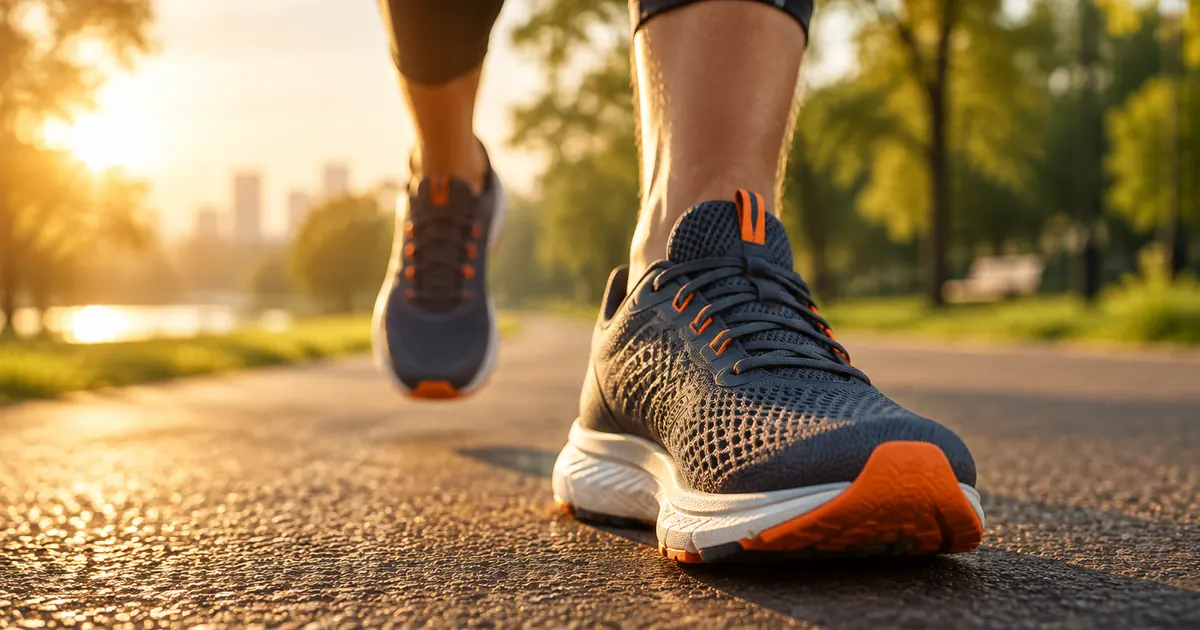
The most common running shoe complaint is not durability or style — it is fit. Shoes that rub, pinch or slide cause the blisters, black toenails and heel pain that quietly end running habits. The good news: choosing a pair that fits is a learnable skill, and it starts long before you look at a single product page.
Start with your foot, not the shoe
Measure at the end of the day
Feet swell through the day and swell further on runs. Measure your foot in the evening, standing, with your full weight on it. Trace the outline on paper and measure length in centimeters from heel to longest toe — which is not always the big toe. That centimeter number is your anchor; every product page at Retro Sneakers maps EU sizes to centimeters for exactly this reason.
Add toe room on purpose
Your running shoe needs 0.5–1cm of space beyond your longest measurement. Feet slide forward on every stride, and a toe box with no room turns toenails into casualties. If you are between sizes, take the larger one for running — snugness at the heel matters more than snugness at the toes.
Mesh uppers earn their place
Upper material decides how your foot handles heat and moisture. Knitted and woven mesh panels let air move through the shoe, which keeps feet drier and blisters rarer. Our Couple Breathable Mesh Running Shoes use an open-weave mesh across the forefoot — the zone that generates the most heat — with a firmer weave at the midfoot for structure.
Leather and heavier synthetic uppers have their place (see our leather collection for smart-casual wear), but for genuine pace work, mesh is the honest choice. If your runs are longer than 30 minutes or your summers are humid, breathability stops being a luxury.
Cushioning: firm enough to feel, soft enough to forgive
Midsole cushioning is a trade-off. Too soft and the shoe feels mushy, unstable and dead after a month. Too firm and every sidewalk joint takes the hit. For daily training on pavement, you want a midsole that compresses under your weight and springs back — press a thumb into the heel and it should rebound within a second.
The Men's Breathable Running Sneakers balance this with an EVA midsole tuned for mixed pace — soft enough for easy miles, stable enough for quicker efforts. For gym work and court sports, the Unisex Badminton Training Shoes run firmer on purpose: lateral movements need a stable platform, not a trampoline.
The three fit checks before you buy
- The thumb test: with the shoe on and laced, you should fit a thumb's width between your longest toe and the shoe's end.
- The heel lock check: walk and jog in place. Your heel should not lift more than a few millimeters. Heel slip is the cause of most blister complaints.
- The flex match: bend the shoe. It should flex at the ball of the foot, roughly where your toes bend — not in the middle of the arch.
Match the shoe to the actual running you do
- Daily easy miles: prioritize cushioning and breathability — a mesh runner like the Men's Breathable Running Sneakers covers most training weeks.
- Mixed gym and run sessions: a training shoe with a firmer platform handles both without compromise.
- Walking-heavy days: our Black & White Walking Sneakers trade some pace cushioning for all-day stability.
Rotate two pairs if you run often
Midsole foam needs about 24 hours to decompress after a run. Running in the same pair every day compresses it faster than the miles alone would. Two alternating pairs each last longer than one pair run into the ground — the math favors the rotation, and it gives your gait slightly different loads, which reduces overuse niggles.
When to replace running shoes
Watch for three signals: the outsole tread is smooth at the heel strike zone, the midsole no longer rebounds after you press it, or you start feeling the pavement through the shoe on familiar routes. At that point the shoe is done — pushing on invites shin and knee complaints that cost far more than a replacement pair.
Weight and stack height: the feel factors
Two numbers shape how a shoe feels before you take a step. Weight decides how much work your legs do lifting the shoe every stride — a difference of 50 grams per shoe adds up over thousands of steps. Stack height (the sole's thickness at the heel) decides how much ground you feel: lower stacks give better balance for gym work, higher stacks forgive pavement. Our mesh runners sit in the versatile middle — light enough for pace, thick enough for sidewalks.
Break-in: what is normal and what is not
A proper fit needs no break-in beyond two or three short walks while the upper molds to your foot. If a shoe needs "weeks to break in," it does not fit — that language is how stores excuse the wrong size. Mesh uppers adapt within a wear or two; leather softens over a few weeks but should never hurt. Pain past the third wear is a return, not a rite of passage.
Ready to pick your pair? Start with the running & performance collection — every style ships free, tax free, with 30 days to test the fit.
Train in gear that passes the tests
Every Retro Sneakers piece is squat-tested, wash-tested and wear-tested before it ships. Free US shipping, tax free, 30-day returns.
Shop Bestsellers