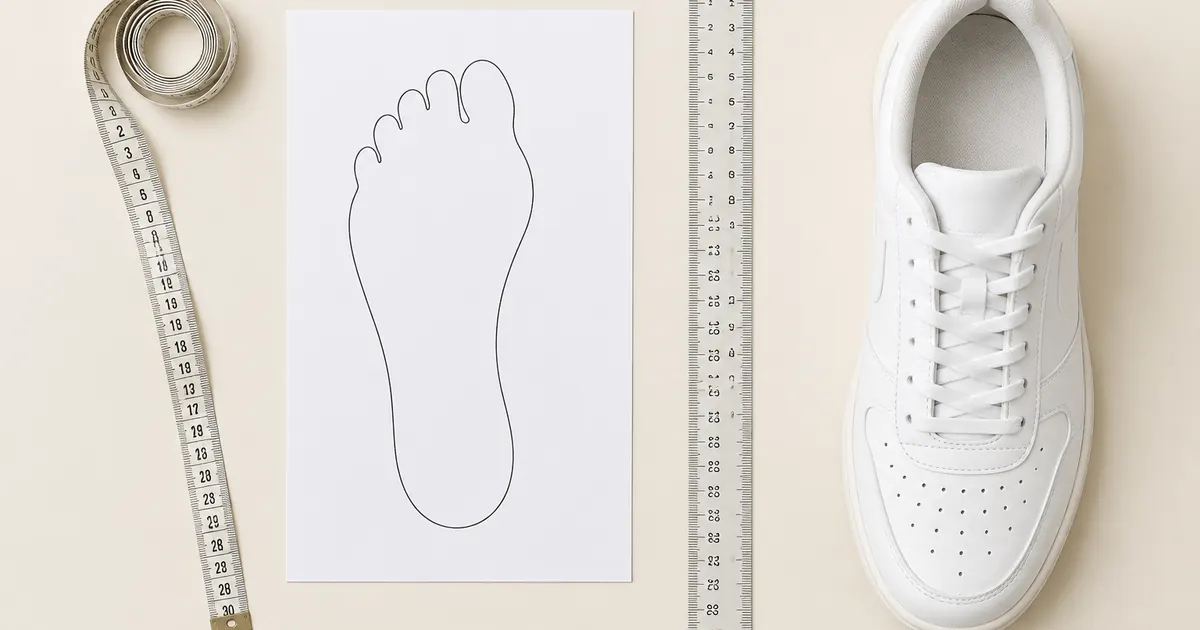
Ordering shoes online dies on one question: what size am I, actually? EU sizing looks unfamiliar to US shoppers, conversion charts contradict each other, and the wrong guess means a return shipment. This guide fixes the problem with the method that shoe fitters actually use — measuring in centimeters — plus a conversion table for reference.
Why conversion charts disagree
EU sizes count shoe lasts (the forms shoes are built on), not feet. Different manufacturers build their lasts with different allowances, so a EU 42 from one brand can fit like a 41.5 or 42.5 from another. Any chart that promises an exact US equivalent is lying to you by a few millimeters. The fix is to measure your foot directly and use the brand's own centimeter mapping — which is why every Retro Sneakers product page lists the exact centimeter length for each EU size.
The centimeter method (do this once)
- Tape a sheet of paper to a hard floor against a wall.
- Stand on it with your heel touching the wall, full weight on the foot.
- Mark the tip of your longest toe (not always the big toe).
- Measure wall-to-mark in centimeters.
- Measure both feet — use the longer measurement.
- Add 0.5–1cm of toe room and match that total to the size chart.
Measure in the evening: feet swell through the day, and a morning measurement is a half-size lie waiting to become a blister.
Conversion reference: EU 35–48
For our sizing, which runs true to the EU scale:
- EU 35–36 ≈ US Women's 5–6 / US Men's 4
- EU 37–38 ≈ US Women's 6.5–7.5 / US Men's 5–5.5
- EU 39–40 ≈ US Women's 8–9 / US Men's 6.5–7.5
- EU 41–42 ≈ US Women's 9.5–10.5 / US Men's 8–8.5
- EU 43–44 ≈ US Men's 9.5–10.5
- EU 45–46 ≈ US Men's 11–12
- EU 47–48 ≈ US Men's 12.5–13.5
Treat this as a starting point, not gospel. The centimeter method above outranks any table, including this one.
Width: the dimension charts forget
Two feet can measure the same length and need different shoes. If standard-width shoes always pinch your little toe or the ball of your foot, look for mesh uppers — they stretch and breathe. Our Korean Style Breathable Mesh Sneakers run forgiving on width because the knit gives where leather would press. Conversely, if shoes feel loose at the same length, leather or heavier canvas holds the foot better — see the Men's Sports Casual Leather Sneakers.
Size notes for specific models
- Mesh runners (like the Couple Breathable Mesh Running Shoes): take your measured size plus toe room; the knit adapts.
- Leather shoes: leather softens and molds over the first weeks, but it does not stretch in length. Order your measured size, not a size up.
- Slip-ons (like the Men's Slip-On Leather Dress Shoes): a snug initial fit is correct — they relax about a quarter size with wear.
When the fit is still wrong
Even careful measuring misses sometimes — that is why every order ships with 30-day returns and free size exchanges. If the fit is off, email support@retrosneakers.shop with your order number and the size you need; we handle the swap. One honest exchange beats a shoe that never leaves the box.
Kids and smaller feet: the same method scales
The centimeter method works identically for smaller feet, which is why our unisex styles run down to EU 35. Measure the same way — wall, paper, mark, evening measurement — and match the centimeter total. For growing feet, add a full centimeter of toe room rather than half, and re-measure every season; children's feet can grow two sizes in a year.
Half sizes and in-between measurements
If your measurement lands between two EU sizes, the decision is material-based. Mesh and knit uppers flex across a half-size gap — take the smaller size for a locked-in feel or the larger for width. Leather does not stretch in length, so in-between measurements in leather should always round up. When genuinely stuck, order both and return one: the 30-day window exists for exactly this.
Sizing for the unisex and couple styles
Unisex sizing trips people up because the same EU size fits differently depending on the last's width. Our unisex styles — the badminton trainers and the couple's mesh runner — are graded on a neutral last that runs true to the EU chart for both men and women. Women ordering these should use their measured centimeters directly rather than converting through a men's chart; the centimeter method sidesteps the gendered-sizing maze entirely.
The size you think you are vs. the size you measure
Run the measurement and compare it to what you usually order — the gap is often surprising. Most people who report sizing problems have been wearing a half-size small for years, compensating with stretched-out uppers. If your measurement comes out bigger than your usual size, trust the measurement: the first week in the correct size feels strangely roomy, and then every other shoe starts feeling wrong instead.
Measure once, write the centimeters in your phone, and every future order becomes a ten-second decision. Browse the casual sneaker collection and put the number to work.
Train in gear that passes the tests
Every Retro Sneakers piece is squat-tested, wash-tested and wear-tested before it ships. Free US shipping, tax free, 30-day returns.
Shop Bestsellers